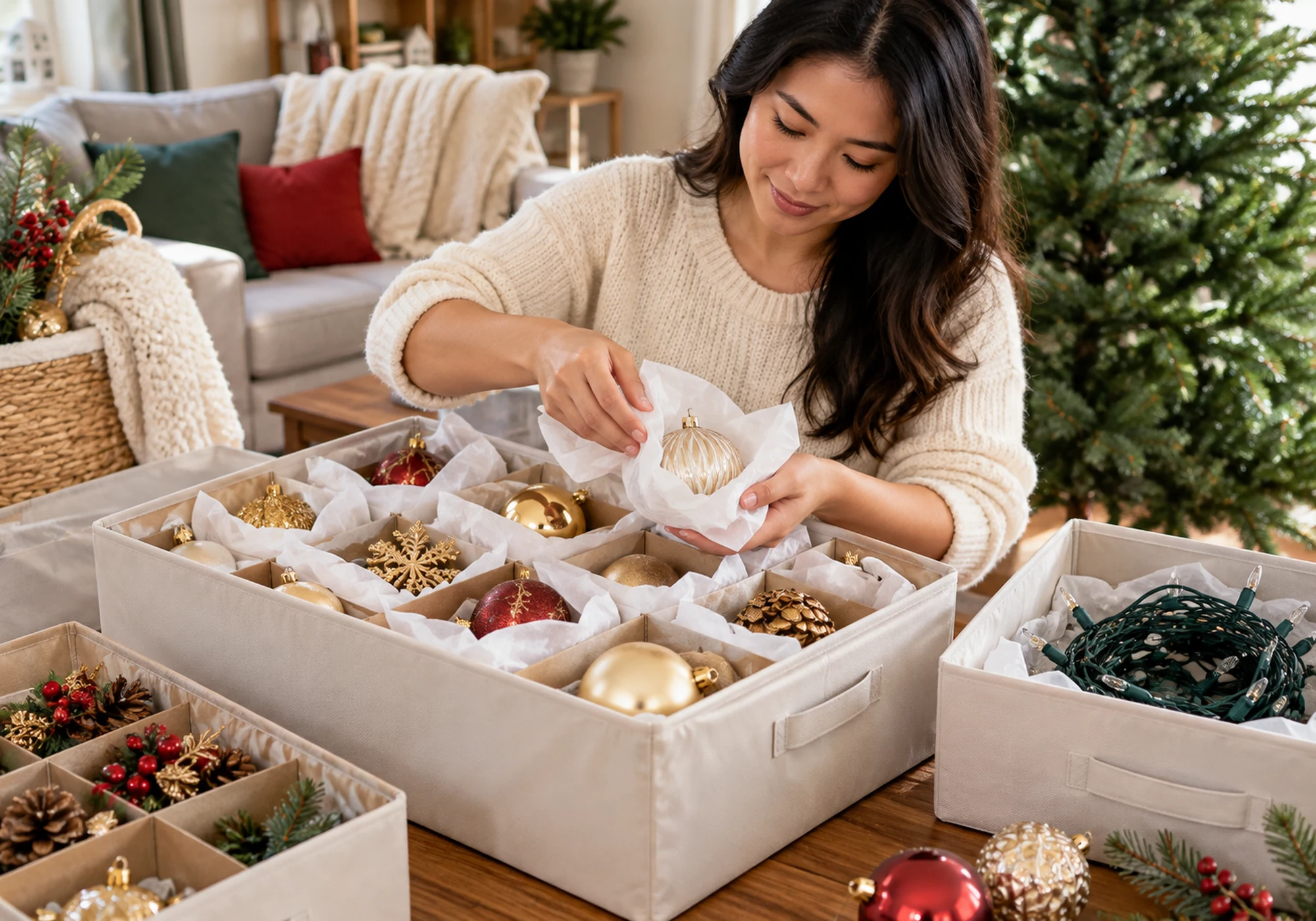
To clean and store holiday decorations, sort them by material and condition, remove ordinary dust gently, and use wet cleaning only when the maker permits it. Inspect unplugged powered decorations according to their instructions. Pack only ready, fully dry items in suitable protective storage, keeping damage and repair decisions separate.
Packing decorations is easier when it becomes a planned care task rather than the last job after a long gathering. A single box can contain glass, painted plastic, fabric, metal, paper, wire, and electrical parts. Those items should not all receive one spray or be pressed into the same unprotected corner.
This guide focuses on the decorations themselves. For a wider seasonal home reset, see our seasonal cleaning service. Room cleaning and careful packing can be coordinated, but the handling of fragile or powered items needs a defined scope.
Sort before cleaning or packing
Prepare a clear table or another suitable supported surface. Group items by care requirements: fragile ornaments, fabric pieces, paper decorations, artificial greenery, and powered items. Keep each maker’s instructions with the relevant group.
Check for broken edges, loose fittings, flaking paint, dampness, and damaged cords. Set uncertain items aside for appropriate review. Do not pack a damaged item into the ready group because the lid of the box is waiting to close.
Identify ownership as well as material. A borrowed serving decoration, rented display piece, and family ornament may need different return arrangements. Keep other people’s property in an agreed place until the responsible person approves its handling.
Photograph the display or grouped items if it helps preserve the arrangement. Focus on the objects rather than private household details. A simple record can make next season’s setup easier without requiring an elaborate catalog.
Inspect delicate finishes before touching them
Look for glitter, foil, painted details, beads, fabric trim, and applied coatings. A decoration that appears to be solid glass may still have a fragile surface treatment. Read the whole product’s care guidance rather than choosing a method from the main material alone.
Avoid scrubbing a leaf, ornament, or ribbon to see whether a mark will come off. Test only where the maker permits, using a small discreet area. Let any approved damp test dry before judging its appearance.
Sentimental and antique items deserve a separate decision. An owner may prefer limited handling to the risk of losing an original finish. Suitable conservation advice is more useful than promising that every inherited object can be made to look new.
| Item group | What to confirm | Packing priority |
|---|---|---|
| Fragile glass or delicate ornament | Finish and permitted dusting | Individual support and separation |
| Fabric decoration | Wash, spot-clean, or specialist-care label | Fully dry material without crushing trim |
| Paper or cardboard item | Whether cleaning is appropriate at all | Dry support away from pressure |
| Artificial greenery | Leaf, base, and any lighting directions | Shape protection and controlled handling |
| Powered decoration | Inspection, disconnection, and storage guide | Intact components with suitable organization |
Remove ordinary dust gently
Use a clean soft brush or cloth approved for the item. Support the decoration rather than holding it only by a delicate hanger or glued attachment. Work over a suitable surface so a small piece does not drop straight onto a hard floor.
Keep the tool free of grit and cleaning-product residue. A cloth used on furniture polish or kitchen grease should not touch a fragile painted ornament. Change tools or clean sections as needed rather than spreading collected material across the next item.
Avoid vigorous shaking, scraping, or compressed air on an uncertain fragile object. Those methods can dislodge a coating or weak attachment. If dust cannot be removed through the permitted gentle method, ask for product-specific advice.
Collect fallen material from the working surface separately. Keep sharp fragments and damaged pieces outside ordinary hand sorting. Do not push a broken ornament into soft packing material where someone may reach without seeing it later.
Use wet methods only where permitted
Follow the exact care guide for washable or spot-cleanable pieces. Control moisture and protect glued joints, paper layers, and decorative surfaces. A washable fabric panel does not establish that its sequins, wiring, or backing can be soaked.
For removable textile items, follow the complete laundering and drying instructions. Keep detachable parts together and label them without applying adhesive directly to delicate material. Do not use a hot setting to finish quickly unless the product allows it.
Avoid household recipes, metal polish, glass cleaner, or disinfectant as a universal decoration treatment. The intended decorative finish may differ from an ordinary household fixture made of the same broad material. Keep cleaning and refinishing as separate tasks.
If an item has damp-storage damage or suspected growth, pause ordinary handling and seek suitable advice. Repacking it with ready decorations does not resolve the source. Review the storage location too, using our home moisture prevention guide as a planning reference.
Check powered decorations while disconnected
Switch off and disconnect according to the maker’s instructions before handling. Inspect visible cords, plugs, battery compartments, and fittings without opening sealed electrical parts. Keep liquid away from components not designed for wet cleaning.
Follow instructions for batteries and long-term storage. Do not leave a leaking or damaged battery in place or attempt an improvised repair. Arrange appropriate handling and replacement advice for a suspect component.
Keep a damaged light string or powered ornament out of the ready-to-use group. Cleaning does not repair insulation, wiring, or an unsafe connection. Have the appropriate person assess whether the item should be repaired, replaced, or disposed of through the suitable route.
Coil and store intact light strings only as directed, avoiding tight bends and pressure on vulnerable connections. Keep matching adapters and controllers identifiable. A similar-looking power supply is not automatically a compatible replacement.
Give artificial greenery room to keep its shape
Follow the greenery maker’s dusting, shaping, and storage instructions. Support branches and avoid repeated force at one joint. If lights are integrated, preserve their routing and avoid pulling them to reshape the foliage.
Use a suitable container or storage bag that supports the item without crushing it. A wreath, garland, and small tabletop arrangement can need different packing arrangements. Do not force the piece into an undersized box simply because that box fits the cupboard.
Keep fragile applied details separate from pressure points. Identify any removable pieces and retain their assembly information. A quick photo can help match a topper, stand, or attachment to the correct decoration next season.
For mixed decorative foliage, apply the same material-specific thinking used for household artificial plants. Dry dusting, any approved damp care, base protection, and lighting checks remain separate decisions rather than one full-immersion wash.
Choose packing materials for the actual item
Use clean suitable dividers, supports, and wrapping that do not stick to a delicate finish or transfer color. For valuable or old objects, ask a preservation specialist about appropriate materials. Do not assume that any newspaper or adhesive wrap is suitable for long-term contact.
Pack heavy and fragile items so they do not press into one another. Keep a manageable box weight and follow the container’s capacity. A strong-looking lid does not establish that the contents can tolerate another box stacked on top.
Protect protruding hangers and points without bending them under pressure. Keep small removable components in a clearly identified suitable container. Avoid loose tiny pieces at the bottom of a deep box where they can be lost or damaged.
Label the outside with the item group, room, and any handling restriction. Keep labels off delicate decorations themselves unless the maker permits them. A clear box inventory reduces unnecessary unpacking when one specific item is needed.
Store in conditions the products can tolerate
Follow each item’s requirements for temperature, moisture, light, and storage position. A hot roof space, damp cabinet, or exposed balcony may be unsuitable even if it is convenient. Check the actual conditions rather than relying only on the room’s name.
Do not seal damp items inside a box. Confirm readiness across fabric folds, pot bases, and any approved cleaned surfaces. The container should protect ready items, not hide unfinished drying.
Keep storage away from leaks and maintain access for condition checks. Avoid blocking exits, electrical equipment, or required building access. Heavy boxes should be placed using an appropriate handling plan rather than lifted overhead in a hurry.
Review the location after a leak, move, or major room change. A storage area that worked one year may no longer meet the same conditions. Update the packing record when items are replaced or their care instructions change.
Make unpacking easier next season
Keep a short inventory with box identifiers and a note of any item awaiting repair or replacement. Remove unavailable pieces from the ready list so the household does not plan a display around something that was never fixed.
Store assembly instructions with matching stands, brackets, and controllers. If a part belongs to a rented or borrowed display, keep that ownership clear. Avoid mixing unrelated hardware into one anonymous bag.
For example, one box might contain supported fragile ornaments, while a separate identified container holds an intact light string and its correct controller. A fabric decoration can remain outside both until its approved washing and drying process is complete. The sequence follows condition rather than the urge to finish all packing at once.
Our small-apartment cleaning schedule can help place the final room cleanup after decorations are packed. Cleaning the cleared shelf or corner becomes easier once the stored items have a suitable destination.
Define help with packing before the visit
If you want assistance, specify dusting, permitted cleaning, packing, labeling, and moving as separate tasks. Identify fragile pieces, no-touch items, storage height, and who makes repair or disposal decisions. Provide the care information in advance.
Our house helper task-list guide can help make the request concrete. Confirm that the provider accepts the items and handling involved. General home cleaning does not automatically include conservation, electrical repair, heavy lifting, or high-access dismantling.
Review the finished boxes for clear identification, appropriate support, and a recorded location. Keep unresolved items separate and assign their follow-up. A successful packing session leaves both the home and the next seasonal setup easier to manage.
Review one box before closing it
Choose a decoration box and compare its contents with the ready list. Confirm that each item belongs there, has completed any approved care, and has suitable support. Keep damaged or uncertain pieces outside the box with an identified follow-up rather than hiding them beneath wrapping.
Check that matching components remain recognizable. A controller, stand, and removable attachment should not become anonymous spare parts. Keep assembly information with the appropriate item and use an external box label that can be read without opening every container.
Consider how the box will be carried and where it will rest. Protect fragile contents from pressure and follow the container’s handling and capacity instructions. Arrange suitable help for lifting or access rather than creating a difficult storage position that will need to be reversed next season.
Before closing, ask whether the box can be reopened without scattering tiny parts or exposing someone to a damaged edge. The packing arrangement should support both storage and retrieval. A final ordinary photograph of the layout can make the next unpacking session easier.
Record the storage location and any item deliberately left out. This closes the task with a clear outcome: ready items protected, unresolved items visible, and the household able to find the correct box when needed.
Frequently Asked Questions
Can I donate spare holiday light strings?
Ask the receiving organization whether it accepts powered decorations and what condition or verification it requires. Do not donate a damaged electrical item as ready for use. Follow the appropriate local disposal route for anything the recipient will not accept.
How can I keep a family story with an heirloom ornament?
Write the note separately and store it in a suitable protective enclosure beside the item’s inventory record. Avoid attaching tape or glue directly to the ornament. Ask a preservation specialist about materials when the item or note has significant value.
What should I check before using removable wall hooks for next season’s decorations?
Review the hook maker’s surface, load, installation, and removal instructions, along with the wall finish’s care requirements. Confirm any property-owner restrictions. A removable label does not guarantee compatibility with every painted or decorative surface.