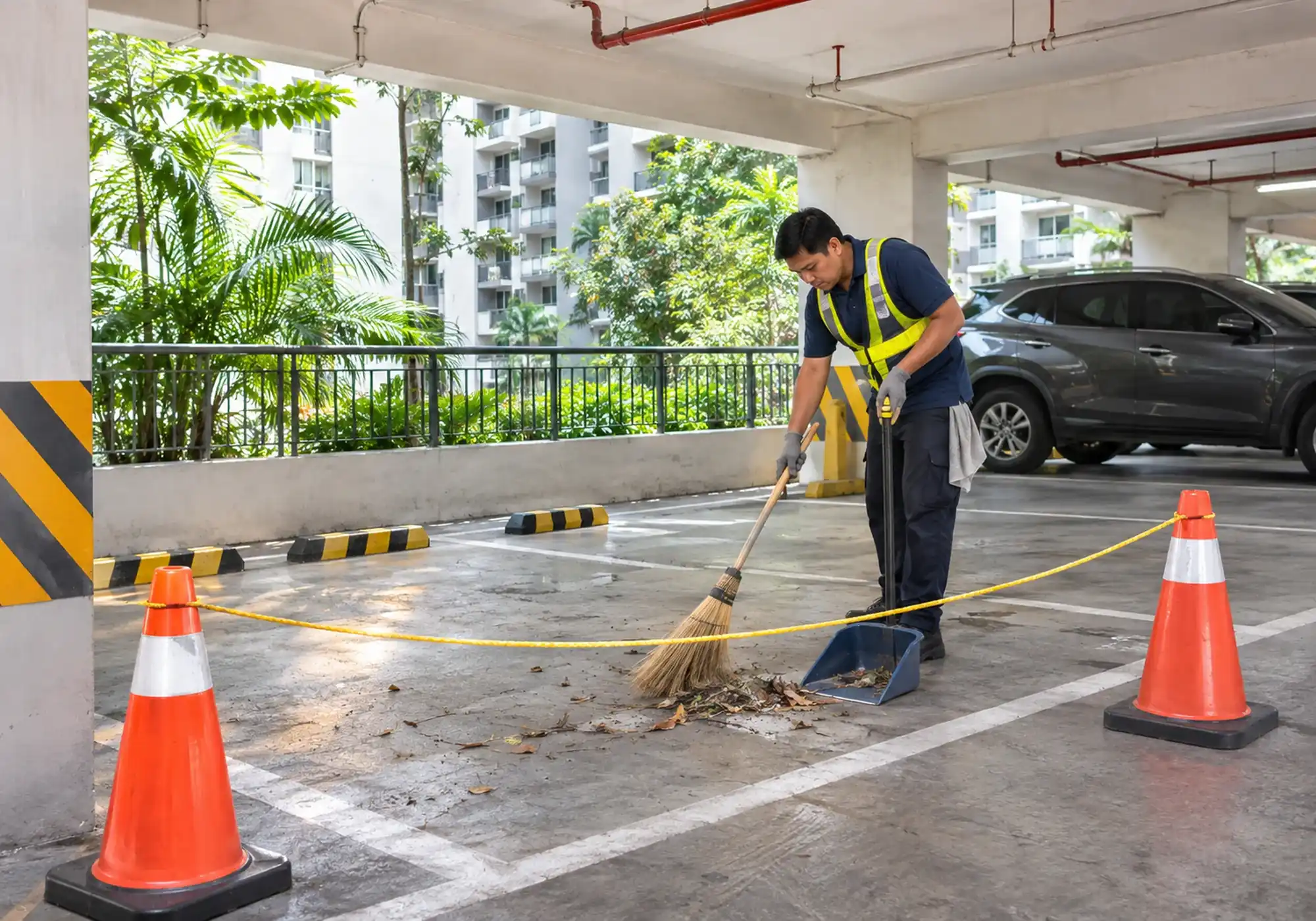
Parking area cleaning needs a traffic and runoff plan before any sweeping or washing begins. Identify the surface, separate ordinary debris from unknown spills, control vehicle and pedestrian access, and use a method compatible with the floor. Fuel, unidentified chemicals, and significant leaks belong outside routine cleaning. A cleaner parking bay should be dry and ready for use under the property’s agreed reopening checks.
Quick cleaning checklist
- Survey the surface and identify the soil.
- Coordinate vehicle and pedestrian routes with management.
- Keep unknown spills outside routine cleaning.
- Confirm containment and wastewater arrangements.
- Reopen only after the agreed site checks are complete.
Survey the surface and type of soil
Walk the area with the property contact before choosing equipment. Note bare concrete, painted markings, coated floors, ramps, wheel stops, drains, and nearby electrical equipment. The same cleaning product may affect a coating differently from untreated concrete. Obtain available floor-care instructions and identify damaged areas.
Separate dust, leaves, tire marks, oil-like drips, and unknown substances. Do not assume a dark patch is ordinary motor oil or that every stain can be removed. Record old discoloration and surface damage so the expected result is clear. If a spill is unknown, actively leaking, or associated with fuel or another hazardous substance, keep people away and follow the property’s appropriate response process. A routine cleaning quote should not casually include chemical-spill response or vehicle repair.
Plan traffic control with management
Agree which bays or sections can be taken out of service and when. Coordinate vehicle movement with the people authorized to handle it. Cleaners should not move residents’ cars or keep keys unless a separate authorized arrangement exists. Establish a managed pedestrian route and keep required emergency access available.
Barriers, notices, and staff instructions need to match the actual site conditions. A cone alone is not enough if drivers can enter the wet zone from another direction. Check ramps, corners, and low-visibility areas. Schedule around deliveries and busy arrival times. If the site cannot provide safe separation, revise the timing or method. Traffic planning belongs in the scope because equipment, water, and cleaning staff should not compete unpredictably with moving vehicles in the same space.
Remove dry debris without spreading it
Collect accessible litter and leaves using appropriate tools and the property’s waste arrangements. Handle sharp objects or unusual waste through the relevant procedure rather than picking them up casually. Use suitable dust-control methods for the surface and environment instead of dry sweeping fine material into occupied areas.
Keep debris out of drains and away from parked vehicles. Do not blow dust toward open windows, pedestrians, or neighboring bays. Choose equipment that fits the aisle and can be used within the managed zone. Inspect around wheel stops and wall edges from a stable position. Avoid reaching beneath a vehicle to retrieve debris without a safe plan. The dry stage should leave less loose material for any later washing process, reducing the chance of turning grit into slurry that spreads beyond the work area.
Treat known drips within an agreed method
For a small, identified nonhazardous residue within a provider’s capability, follow the floor and product instructions. Test compatibility where needed and protect painted lines, coatings, and adjacent materials. Do not pour concentrated degreaser onto every dark mark or extend contact time beyond the label.
Use the specified process for containing and collecting residue. Do not direct oily wash water into a drain as a shortcut. If the stain remains, consider whether it has penetrated the surface or reflects permanent discoloration. Repeated aggressive treatment can damage a coating without producing a uniform result. Record that limitation. An active vehicle leak should be addressed by the vehicle owner through appropriate repair, otherwise the same patch may reappear immediately. Cleaning cannot solve the source of a recurring mechanical leak.
Confirm drainage and wastewater arrangements
Identify drains and ask management how cleaning wastewater must be handled. Do not assume every grate leads to a system suitable for detergent, oil, or sediment. Obtain the site’s instructions and any required disposal arrangements before wet work begins. Keep collected debris separate from liquid waste where the procedure requires it.
If containment and collection cannot be managed, change the method or postpone the task. Avoid flooding a parking level to push dirt out of sight. Water can travel into neighboring bays, lift areas, electrical spaces, and lower levels. Report blocked drains or unexplained pooling as maintenance issues rather than trying to clear concealed pipework during surface cleaning. A useful plan identifies who approves the wastewater route and who confirms the area is left without uncontrolled runoff.
Choose equipment for the finish and space
A mop, scrubber, pressure washer, and wet-recovery system are different tools with different access and surface implications. Select equipment through the floor-care instructions, soil condition, and site’s operating limits. Do not assume pressure washing is suitable for every coated floor or enclosed parking area.
Protect electrical fixtures, doorways, sensors, and nearby property from water and overspray. Keep cables and hoses within the managed zone. Consider whether the equipment can turn around wheel stops and operate without striking vehicles or columns. Follow the equipment’s own instructions and use competent operators. If a machine cannot fit safely, use a suitable alternative or revise the scope. The site’s warehouse floor planning guide provides a related traffic-coordination context, while parking-specific access and runoff still need their own decisions.
Keep shared building areas in the agreement
Parking work often connects to lift lobbies, stairs, storage rooms, and pedestrian entrances. Define where the task ends so debris and moisture are not simply moved into the next space. Keep clean and dirty travel routes controlled, and protect areas already returned to use.
Discuss the work within commercial deep cleaning or a defined janitorial arrangement, subject to provider capability. Do not infer that every specialist spill, height-access task, or drain repair is included. Provide photographs, dimensions, floor information, and operating restrictions when requesting a quote. Ask who supplies barriers, who coordinates vehicles, and who signs off reopening. Those details influence whether the job can be delivered as planned more than a simple price per square meter.
Inspect and reopen through a clear handoff
Review the treated area for remaining moisture, loose grit, residue, and equipment. Check drains and adjacent spaces for unintended runoff without opening concealed systems. Inspect painted markings and coatings for changes, comparing the initial condition notes. Record any permanent stain separately from missed work.
Follow the property’s agreed readiness checks before removing barriers. Do not reopen a ramp or bay merely because part of it looks dry. Confirm who authorizes the return of vehicles and communicates with residents or staff. Keep a short record of completed sections, remaining defects, and recurring leak locations. This makes future maintenance more targeted and avoids repeatedly treating a patch without telling the person who can address its source. A clean handoff is part of a parking-area service, not paperwork added after the equipment leaves.
A practical sequence for a residential parking bay
Imagine one empty bay with leaves, fine grit, and an old identified stain. Management confirms the working window and a safe pedestrian route. The provider records the floor coating, removes loose debris using an appropriate method, and tests any permitted stain treatment. Wastewater collection is agreed before wet work starts.
If the stain does not improve within the safe method, document it rather than applying a stronger unidentified chemical. Inspect the bay and surrounding route, then keep barriers in place until the agreed readiness check is complete. When the resident returns, explain any remaining discoloration and whether a leak source needs attention. This produces a useful, reviewable result without claiming that every parking mark can be erased or that ordinary cleaners can respond to every type of spill.
Frequently Asked Questions
Can residents store cleaning supplies in a parking bay?
Check the property’s storage rules and product storage requirements.
Who can authorize moving an abandoned vehicle?
Refer the matter to building management and the appropriate authorized process.
Can line repainting be added to a cleaning visit?
Arrange it separately with suitable surface preparation and coating guidance.
Should contractors receive access cards?
Use the building’s approved contractor-access process.
Can a tenant install a drip tray under a car?
Check building rules and select a suitable product with the vehicle owner’s input.