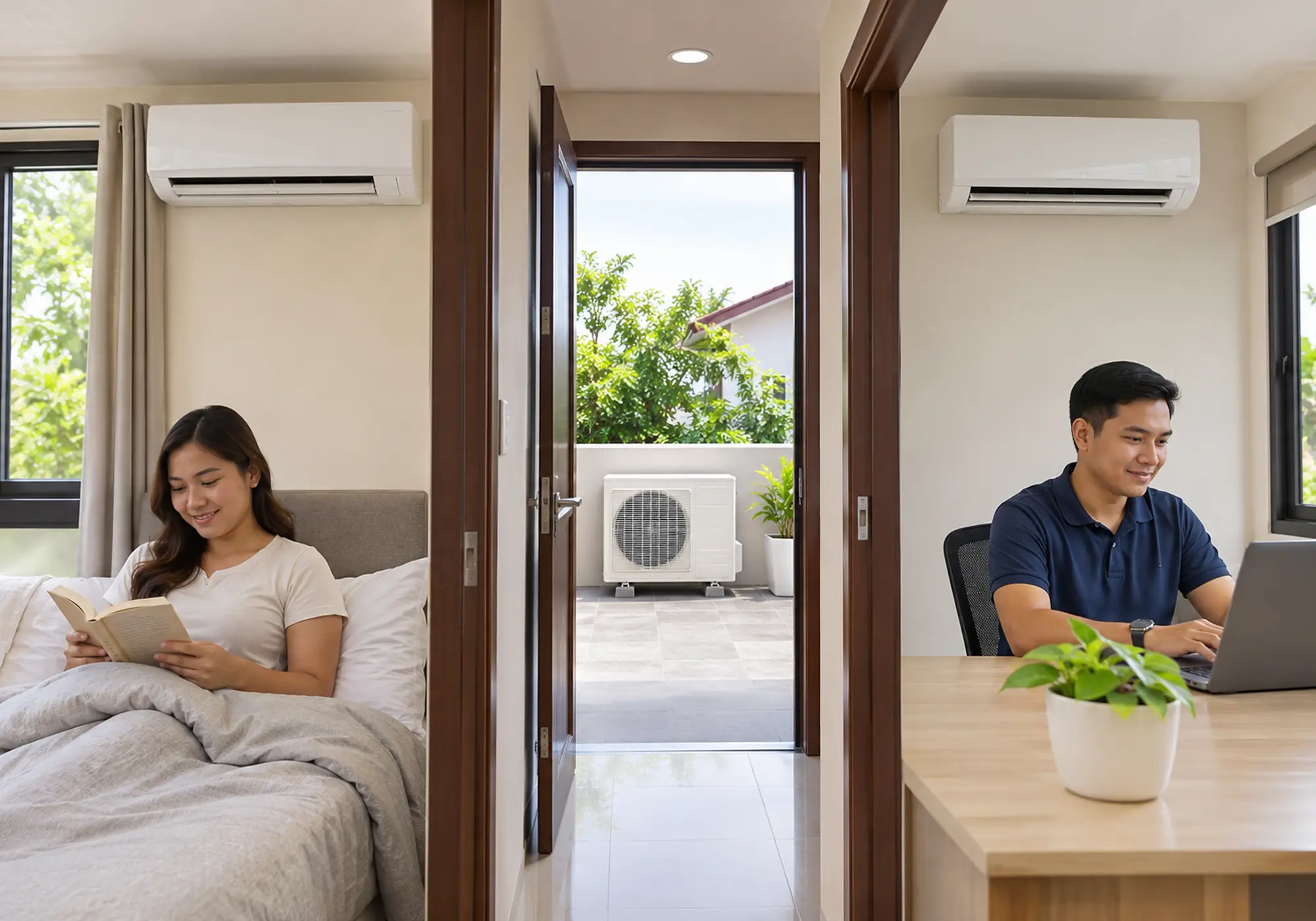
Larger or less accessible aircon types usually need a site-specific quotation. For a published Philippine reference as of October 2026, Teko lists ₱2,550 per tower unit and ₱3,675 per cassette, suspended, or concealed unit. These are one provider’s advertised fees, not Cleaning Services PH prices or a complete estimate for every installation. Ceiling height, access panels, unit count, drainage, and operating hours can change the scope significantly.
Floor-mounted, cassette, suspended, and concealed aircons are common in Philippine offices, stores, and larger homes, yet their cleaning quotations are harder to compare than a standard window-unit price. Yet a commercial aircon quotation cannot be judged only by the unit label. A floor-mounted unit in an open showroom, a cassette over a busy reception desk, and a concealed unit above a finished ceiling create different access and protection needs. This guide shows facility managers, condo owners, and small businesses how to specify the job so quotes cover comparable work.
Identify the equipment before asking for a price
A tower or floor-mounted aircon stands within the room. A cassette generally sits in a ceiling with a visible panel and distributes air in multiple directions. A suspended unit hangs near the ceiling, while a concealed unit may sit behind a panel or within a ducted arrangement. The names matter because they affect access, drainage, cleaning time, and the equipment required. Do not send only a photo of the remote control and expect an accurate quote.
List the brand and model, unit capacity, number of indoor and outdoor sections, installation height, and exact location. Photograph the front panel and any safe-to-view access hatch. Note whether the space is a shop, clinic, office, home, restaurant, or warehouse. A provider can then decide whether a routine visit is possible or an on-site survey is needed. The site’s floor-mounted and cassette-type guides explain the basic distinctions.
What published specialty rates do and do not cover
Teko’s published aircon cleaning menu lists a tower at ₱2,550 per unit and cassette, suspended, and concealed types at ₱3,675 per unit. That menu is a useful benchmark for the fact that these types are not necessarily priced like a common wall split. It is not a universal rate. Ask whether the advertised or quoted figure includes panel removal, coil and blower cleaning, filter and drain work, outdoor-unit access, protection for fixtures, and operation testing.
Higher ceilings, restricted entry, many units, or heavy buildup may require additional labor and a different schedule. If a provider quotes per indoor unit, a building with several cassettes cannot simply be priced as one system because they share an outdoor plant. Request a written count and the exact units covered. Do not compare a single-unit web price with a full office maintenance contract without aligning the scope.
Floor-mounted and tower units: reachable does not mean simple
A floor-mounted unit may be easy to reach, but it often operates in a high-traffic environment and draws in dust from a large occupied space. The technician needs room to open panels, protect nearby goods, and handle wastewater. Ask whether the quote covers filters, reachable coil and blower surfaces, drain, casing, and the exterior section where applicable. If a unit sits in a store entrance, plan the service when customers and staff will not be exposed to the work area.
Identify any odor, uneven cooling, or water pooling before the appointment. A cleaning visit can remove deposits, but it cannot automatically resolve a failing fan or damaged drain assembly. If a floor-mounted unit is in a shared building, coordinate power isolation and access with the facilities team. The store cleaning service can help with the surrounding space, but appliance servicing should have its own task list.
Cassette units: overhead work needs protection
A cassette sits above occupants, furniture, electronics, and floor finishes. Ask how the technician will protect the area below and safely reach the panel. Confirm whether an appropriate ladder or platform is included and whether the ceiling height triggers an extra charge. The drain pump or line may need inspection if the unit drips. A technician should explain how panels will be reinstalled and whether the unit will be tested after cleaning.
A shop or office may need to close an area temporarily. Schedule with enough time for setup, cleaning, drying, reassembly, and handover. If several cassettes share a space, label them on a simple floor plan so the final report matches the actual units. A quotation that says “four aircons” without locations or model types invites confusion when one unit is harder to reach than the others.
Concealed units: find the access route
A concealed aircon may be behind a ceiling panel or serve multiple outlets. The visible vent does not reveal how to reach the filter, coil, blower, drain, or service opening. Before booking, ask the building manager for the mechanical drawings or maintenance notes if available. Locate the access hatch and make sure furniture or fixed joinery does not block it. The concealed-type aircon guide gives more context about this configuration.
Do not assume that cleaning supply vents equals cleaning the indoor unit. A proposal should say which parts are accessible and which are excluded. If opening a ceiling requires a separate contractor or creates a risk to finishes, that needs to be identified in advance. Ask whether the provider can inspect first and quote afterward rather than accepting a fixed “deep cleaning” price that excludes the hardest part of the job.
Suspended units and difficult heights
A ceiling-suspended unit can require a different working platform from a wall unit. Confirm the exact mounting height, space beneath it, and whether power can be isolated safely. The work might disrupt shelving, lighting, or other equipment. Ask whether outdoor access is also included. For an occupied workplace, select a service window that protects employees and allows proper testing before operations resume.
High mounting does not justify an unexplained charge. Ask for the required equipment, time, and safety plan. A provider that cannot safely reach the unit should decline or revise the scope. Do not pressure a technician to balance on furniture or use an unsuitable ladder to preserve a low initial quotation.
What to include in an RFQ for several units
Send a list with one line per unit: ID or room, type, brand and model, capacity, installation height, access route, last service date, symptoms, and preferred service hours. Ask providers to return a unit-by-unit price and describe indoor, outdoor, drain, filter, and test work. Include any site requirements for permits, induction, protective equipment, and waste handling. This makes the quote useful for comparing vendors and verifying the completed job.
For a business, agree on who signs the service report and how faults will be escalated. Keep cleaning separate from repair approvals. If a technician finds a broken pump, refrigerant leak, or damaged electrical part, obtain a separate diagnosis and price. The site’s aircon cleaning service and office cleaning service address different needs and should not be bundled under an ambiguous “general cleaning” label.
Choose the quote that defines the work
Ask about scope, safe access, unit count, follow-up testing, and documentation before focusing on the total. Compare the same equipment and tasks across providers. A specialty unit often costs more to maintain because access and setup take time, but a high price without a clear method is not a better offer. Use a published rate as a reference, then obtain a site-specific quotation for your actual installation.
Plan a repeatable maintenance record
When a property has more than one unit, keep a simple register with its room, type, model, capacity, service date, observed condition, and next review date. The register should distinguish an indoor cleaning from an outdoor cleaning and note when access was unavailable. This is particularly useful in offices where a unit may be serviced during a holiday while the person who reported the original issue is absent. An equipment ID on the invoice and report makes the record auditable.
After each visit, ask a staff member to check the room once it is occupied again. A machine can pass a short operating test but reveal a leak after longer use. If the problem returns, refer to the service report and ask whether the next step is another cleaning, a drain assessment, or a repair. That process prevents repeated broad “deep clean” bookings with no explanation. It also helps managers budget by unit type and arrange safe access before the next service, instead of paying emergency labor when a neglected unit interrupts operations.
Frequently Asked Questions
Can the work be done outside business hours?
Ask for available slots and any after-hours charge.
Who supplies a lift for a high ceiling?
Assign that responsibility in the written quote.
Can units be labeled in the service report?
Yes; request a room or equipment ID for each unit.
Should tenants notify building management?
Yes, check contractor access and shutdown rules first.
Can a technician service one faulty unit in a multi-unit system?
Request a system-specific assessment before booking.