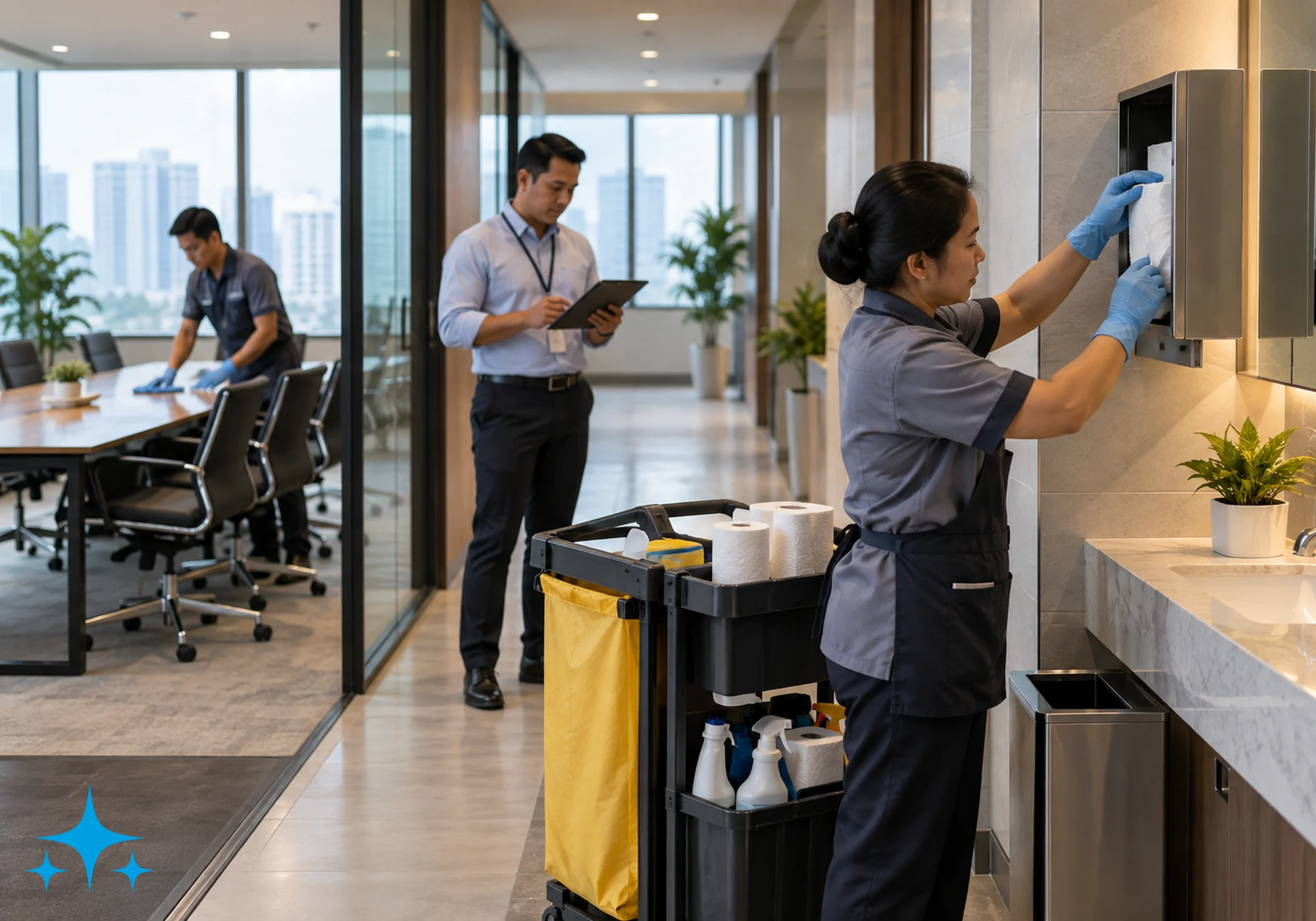
Quick answer: Office cleaning cost depends on the floor area, number of workstations and restrooms, traffic, service frequency, depth, operating hours, and who provides consumables. For one published Philippine example, CMDA lists a starting ₱120–₱140 per square meter for its office deep-cleaning package. That is a specific provider’s advertised starting rate, not a Cleaning Services PH quote or a universal contract price. Routine office upkeep and a one-time deep clean should be quoted separately.
“Office cleaning service” has meaningful search impressions but weak average visibility for the site’s service page. A useful guide needs to help an office manager translate “clean the office” into a measurable scope. A small professional suite used five days a week differs from a round-the-clock call center, a shared coworking floor, or a clinic with its own protocols. This article explains how to request comparable proposals and avoid both missing tasks and unnecessary extras.
Start with the site survey
Measure the areas to be cleaned and count rooms, workstations, meeting spaces, restrooms, pantries, entrances, and any storage area. Note floor finishes, glass partitions, upholstered chairs, and high-touch surfaces. Tell the provider how many people use the office, whether visitors enter, and which areas are occupied during cleaning. A quote based only on square meters can miss a small site with many toilets or a large but mostly empty floor.
Ask the provider to walk through the space or review a floor plan and photos. Identify access restrictions, security zones, loading routes, parking, water, and electricity. The office cleaning service page is the relevant destination for discussing an actual site, while the office cleaning checklist helps define tasks before asking for money figures.
Routine service versus deep cleaning
Routine service might cover bins, floors, desks where access is authorized, pantry surfaces, restrooms, and touchpoints at an agreed frequency. Deep cleaning may add detailed work on walls, high areas, fixtures, cabinets, upholstery, and buildup that ordinary shifts do not address. The terms are not standardized. Ask for a room-by-room list and a frequency next to each task. A weekly glass wipe and a quarterly upholstery extraction should not be hidden under the same one-line “office cleaning” description.
CMDA’s published prices show a starting ₱120–₱140 per square meter for its office deep-cleaning package, with listed tasks such as vacuuming walls and floors, sanitizing workstations and restrooms, and cleaning the pantry. This is not a routine daily contract rate. Use it only as one benchmark for a deep scope and confirm current terms. For an intensive one-time project, see the site’s commercial deep-cleaning service.
Choose frequency from use, not habit
Restrooms and pantries in a busy office may need attention more often than meeting rooms used once a week. Entry floors may collect rainwater and street dust, while a closed executive room may stay relatively clean. Build a task-frequency matrix: daily, several times weekly, weekly, monthly, and occasional. Ask who replenishes toilet paper, hand soap, bin liners, and pantry items. Those materials can materially change the recurring cost.
For a small office, a few scheduled visits might suffice. A larger high-traffic site may need daily shifts or a dedicated team. The recurring commercial cleaning page describes scheduled support. Be specific about holidays, night shifts, and emergency requests. An on-call deep clean is not the same as a predictable maintenance contract.
What a contract quote should itemize
Request the number of workers, hours per shift, days per month, supervisor visits, tasks by area, equipment, cleaning products, consumables, travel, taxes, and any overtime or holiday charges. State whether the company or client supplies storage, water, electricity, and waste collection. Identify security clearance and site induction requirements. If the provider offers periodic deep cleaning, price it as a separate line or explicit scheduled item.
Ask how absences and replacements are handled, how performance issues are reported, and who signs the work log. Avoid a contract that promises a “spotless office” but does not specify whether desks are cleared, monitors are touched, or confidential papers are moved. Define how an extra project is approved and billed. A transparent cost model lets you compare labor hours and outcomes, not just a monthly total.
After-hours and occupied-space work
Cleaning outside business hours can reduce disruption, but may require key management, guards, lighting, and after-hours building access. If cleaning occurs during work, choose methods that keep walkways usable and protect staff from wet floors and equipment. Discuss noisy vacuuming, product odor, and the timing of restroom work. A provider may charge differently for late shifts or holiday coverage, so state the preferred window in the initial request.
For a shared building, confirm the administration’s contractor requirements and waste disposal rules. Do not assume that a cleaners’ access pass permits work in a restricted server room or leased neighboring space. The scope should respect data and workplace security while still allowing the team to complete agreed tasks.
Special surfaces and separate services
Carpet extraction, upholstery treatment, window exteriors, high ceilings, post-construction residue, and aircon servicing need specialized methods. List them separately so the routine bid does not conceal exclusions or charge for work rarely needed. For an office with numerous fabric chairs, the upholstery cleaning service can be quoted by item and condition. A newly renovated office may need post-construction cleaning before ordinary maintenance begins.
Ask for product compatibility on sensitive stone, wood, electronics, and fabric. The cleaners should not rearrange confidential files, unplug active equipment, or use water near electrical systems without a plan. A site-specific method and clear exclusions prevent damage and reduce disputes.
Measure the result
Create a short inspection checklist for entrance, work areas, pantry, restrooms, floors, and bins. Have a named site contact inspect periodically, not only when someone complains. Record missed tasks, access problems, and conditions outside the contract. Ask the provider for a corrective action process and a realistic response time. The measure of value is consistent completion of a useful scope, not a low monthly figure attached to no standard.
Review the scope after occupancy changes. A business that adds a shift, expands desks, or opens a new pantry has changed the workload. Conversely, an area that closes should be removed or scheduled less often. Keep a written variation rather than relying on informal instructions to individual cleaners. This protects the business budget and the crew’s working plan.
Compare proposals on one common request
Send every bidder the same site information, floor plan, task-frequency matrix, hours, consumable responsibilities, and inspection expectations. Ask them to list assumptions and exceptions. One provider may offer more hours, another may include supplies, and a third may price a quarterly deep clean separately. Normalize these differences before selecting a vendor. Request references for work of similar size and verify who manages quality at the site.
Office cleaning service cost becomes easier to evaluate when the quote states what happens, how often, by whom, and with which supplies. Start with the office’s actual use. Then price routine care and occasional projects separately, and review the result against the written scope.
Ask how the price changes
Before signing a recurring agreement, ask what triggers a revision. More staff, longer operating hours, a new pantry, or extra restrooms add work. A partial office closure may reduce it. A fair process identifies the changed area and tasks, proposes a new schedule, and prices the variation before it starts. Without that rule, small ad hoc requests can grow into a disputed bill or leave the crew with an impossible list.
Keep one record of approved variations and review it with the provider at regular intervals. If you are collecting several bids, send the updated scope to every bidder so the comparison remains valid. A predictable review process is valuable even when the initial quote seems straightforward.
Ask each bidder to describe a normal service day from arrival to sign-off. The sequence reveals whether the proposed hours allow for setup, restroom work, floors, restocking, and a final inspection. It also shows when staff and visitors will encounter wet surfaces or equipment. If a quote seems unusually low, compare its actual on-site labor time and the tasks omitted. A realistic schedule protects both the budget and the quality of the workplace.
Frequently Asked Questions
Can a provider invoice monthly?
Ask for its billing cycle and payment terms.
Who holds keys or access cards?
Assign and document this under your security policy.
Can staff request tasks directly from cleaners?
Set an authorized request process to control scope.
Should a trial period be included?
It can help; define duration and review criteria in writing.
Can service continue during a power interruption?
Agree on feasible tasks and a rescheduling rule.