In the Philippines, the air conditioner is more than just an appliance; it is a beloved member of the family. It is our refuge from the relentless tropical heat, our escape from the suffocating humidity of the “ber” months, and the only reason many of us get a decent night’s sleep amidst the noise of the city. We associate the gentle hum of the AC with comfort, safety, and ginhawa (relief).
We come home from a long commute along EDSA, sweaty and exhausted, and the first thing we do is grab the remote and blast the cool air. We trust this machine implicitly. We assume that because the air feels cold, the air must be clean.
But there is a silent, invisible threat lurking behind that plastic cover. What if the very machine you rely on for comfort is actually the source of your unexplained morning cough, your child’s persistent allergies, or that feeling of lethargy that you just can’t shake off?
The uncomfortable truth is that for many Filipino households, the air conditioner is unknowingly acting as a distributor of indoor pollution. The culprit isn’t necessarily a broken machine, but a neglected one. The direct link between a dirty aircon filter and poor indoor air quality is undeniable, and ignoring it could be compromising your family’s health far more than you realize. It’s time to ask the hard question: Is your aircon making you sick?
The Reality of Philippine Air: Outside vs. Inside
To understand the danger inside, we must first acknowledge the reality outside. We all know that Metro Manila and other major Philippine cities struggle with outdoor air pollution. We deal with jeepney smoke, construction dust, burning garbage in some areas, and general urban grime.
When you close your windows and turn on the AC, you assume you are locking pollution out. In reality, you are creating a sealed environment. Your split-type or window unit doesn’t create fresh air; it recycles the existing air in the room. It pulls the air in, runs it over cold coils, and pushes it back out.
The unit is essentially the “lungs” of your room. And just like human lungs, if the intake mechanism is clogged with filth, the entire system suffers.
In our humid climate, the problem is compounded. Dust doesn’t just sit there; it gets damp. The combination of high humidity (alinsangan) and accumulated alikabok (dust) creates a sludge-like layer on filters and internal components that is the perfect breeding ground for things you definitely do not want to inhale.
The Anatomy of a Dirty Filter: What Are You Breathing?
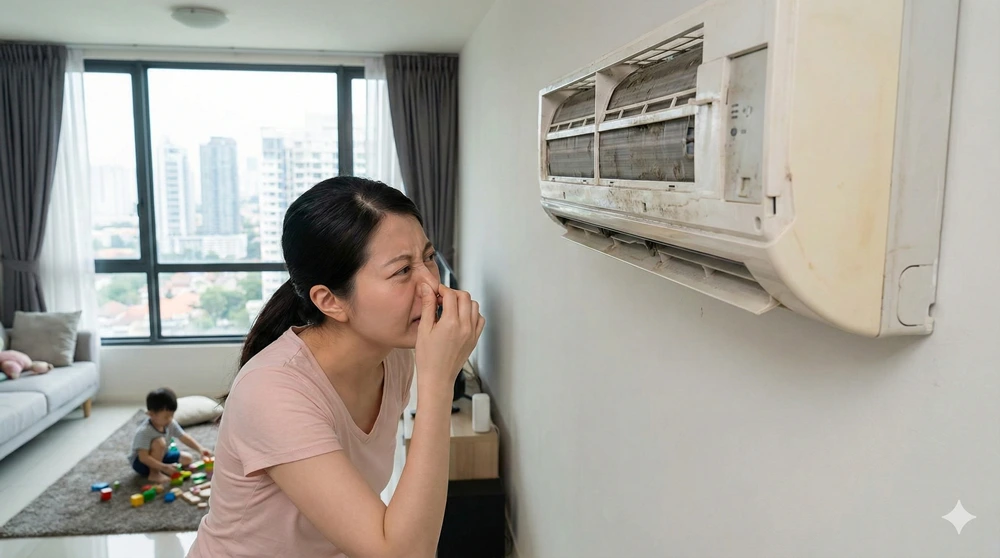
The air filter is your unit’s primary defense system. It’s a simple mesh designed to trap larger airborne particles before they hit the sensitive evaporator coils. When it’s clean, it works like a sieve, letting air pass through while catching dust.
However, many Filipinos are guilty of ignoring this filter for months, sometimes even a year. “Malamig pa naman eh” (It’s still cold anyway) is the common justification for delaying maintenance.
When a filter goes uncleaned, it stops being a sieve and starts becoming a blockage. A thick mat of gray felt forms across the intake. But what makes up this mat? If you took a microscope to a neglected Manila aircon filter, you would find a disgusting cocktail of:
- Human Skin Cells: We shed millions of skin flakes daily, which become the primary component of household dust.
- Dust Mites and Their Feces: These microscopic creatures feed on dead skin. They thrive in our humid climate. Their droppings are a massive allergen trigger for many Filipinos, especially children with asthma.
- Pet Dander: If you have a fur baby inside, their hair and dander are clogging that filter faster than you think.
- Insect Parts: Microscopic bits of cockroaches, ants, and mosquitoes that get sucked into the system.
- Mold and Fungal Spores: This is the most dangerous component. The damp environment of a dirty AC unit is a paradise for mold. Once it establishes a colony on the filter or the coils, the AC begins blowing spores directly into your face while you sleep.
When the air forces its way through this layer of filth, it picks up these contaminants and blows them right back at you. You aren’t filtering the air anymore; you are actively polluting it.
The Health Connection: How It Makes You Sick
So, what happens to your body when you constantly inhale recycled air laced with dust mite feces and mold spores? The effects can be immediate, or they can build up over time.
1. The “Sick Building” Syndrome at Home
Have you ever noticed that you feel lethargic, get frequent headaches, or experience dry, itchy eyes when you spend too much time in a specific room, but feel better when you go outside (even into the heat)? This is often called “Sick Building Syndrome,” and it applies to homes too. A dirty AC fails to circulate air properly, leading to a buildup of carbon dioxide and volatile organic compounds (VOCs) from furniture and cleaners, leaving you feeling sluggish and “pagod” (tired) even after resting.
2. Triggering Allergies and Rhinitis
For the millions of Filipinos suffering from allergic rhinitis, a dirty aircon is public enemy number one. The constant stream of allergens irritates the nasal passages and throat. If you wake up every morning sneezing or with a stuffy nose that magically clears up by lunchtime at the office, your bedroom AC filter is the likely suspect.
3. Asthma Attacks and Respiratory Issues
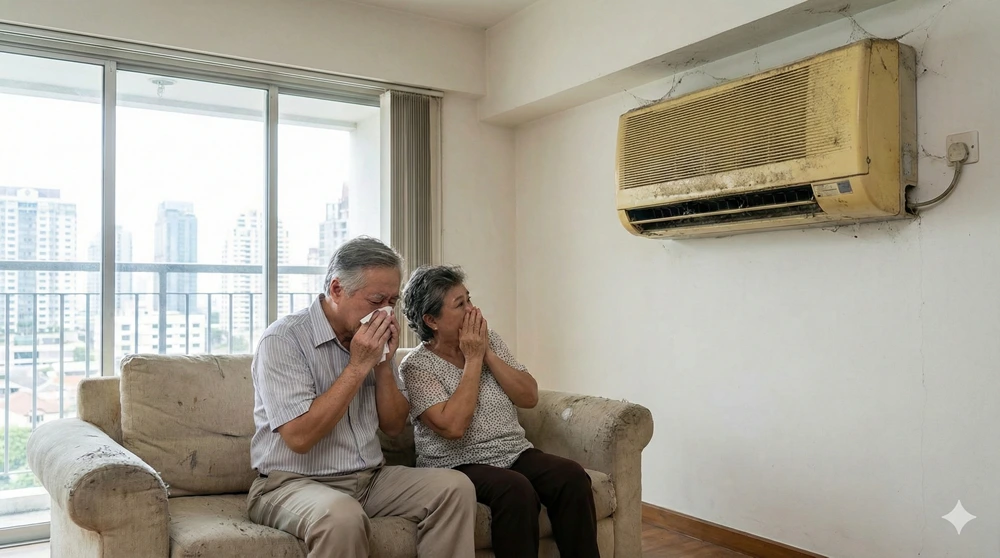
This is where it gets serious. For asthmatics, particularly young children and the elderly (mga lolo at lola), quality air is non-negotiable. The particles blown out by a dirty unit are small enough to bypass the body’s natural defenses and enter the lungs, triggering inflammation and acute asthma attacks. The wheezing and coughing that seem to get worse at night are often directly linked to the machine turned on to help them sleep.
4. The Dreaded Mold Infection
Remember that amoy kulob (musty, damp smell) that sometimes comes out of an AC that hasn’t been used for a while? That is the smell of microbial volatile organic compounds (MVOCs)-gases produced by growing mold. Prolonged exposure to mold spores can lead to fungal infections in the lungs, severe allergic reactions, and even neurological issues in extreme cases. In our very damp climate, if your AC smells musty, it is a health hazard, period.
Busting Common Filipino Aircon Myths
To protect our health, we need to stop believing some common misconceptions about aircon maintenance in the Philippines.
Myth #1: “If it’s blowing cold air, it’s clean.” Fact: False. An Aircon unit can still cool a room even if the filter is dirty, but it has to work much harder (increasing your Meralco bill) and the air it blows is dirty. Cooling ability is not an indicator of air quality.
Myth #2: “Washing the filter is enough.” Fact: It’s a good start, but it’s not enough. Washing the user-removable mesh filter is crucial DIY maintenance that should be done every two weeks. However, fine dust and mold eventually bypass this filter and stick to the internal blower wheel and evaporator coils. This deep-seated dirt requires professional cleaning (often called a “chem-wash” or “general cleaning”) at least every 3 to 4 months in dusty Metro Manila.
Myth #3: “My air purifier will handle it.” Fact: Air purifiers are great, but they are designed to clean the air already in the room. If your AC is constantly pumping new dirt into the room, the air purifier will be overwhelmed. You cannot out-purify a dirty source.
Conclusion: Don’t Sacrifice Health for Comfort
We live in a challenging climate. The heat and humidity make air conditioning practically essential for a good quality of life in the Philippines. But we must stop treating these complex machines like simple electric fans.
The link between dirty filters and poor health is direct and scientifically proven. Every day you delay cleaning that filter is another day you and your family breathe in a concentrated soup of allergens, molds, and bacteria.
Take a moment right now. Stand up, go to your AC unit, pop the front cover open, and look at the filter. If it’s covered in a gray blanket of fuzz, don’t just close it and promise to do it next week. Take it out and wash it.
Your air conditioner is supposed to provide sanctuary, not sickness. Don’t let neglect turn your source of comfort into a source of chronic illness. Clean air isn’t a luxury; it’s a fundamental requirement for a healthy life.